Internal Combustion Engines vs. Battery Operated Vehicles

‍Posted on 2026-09-19

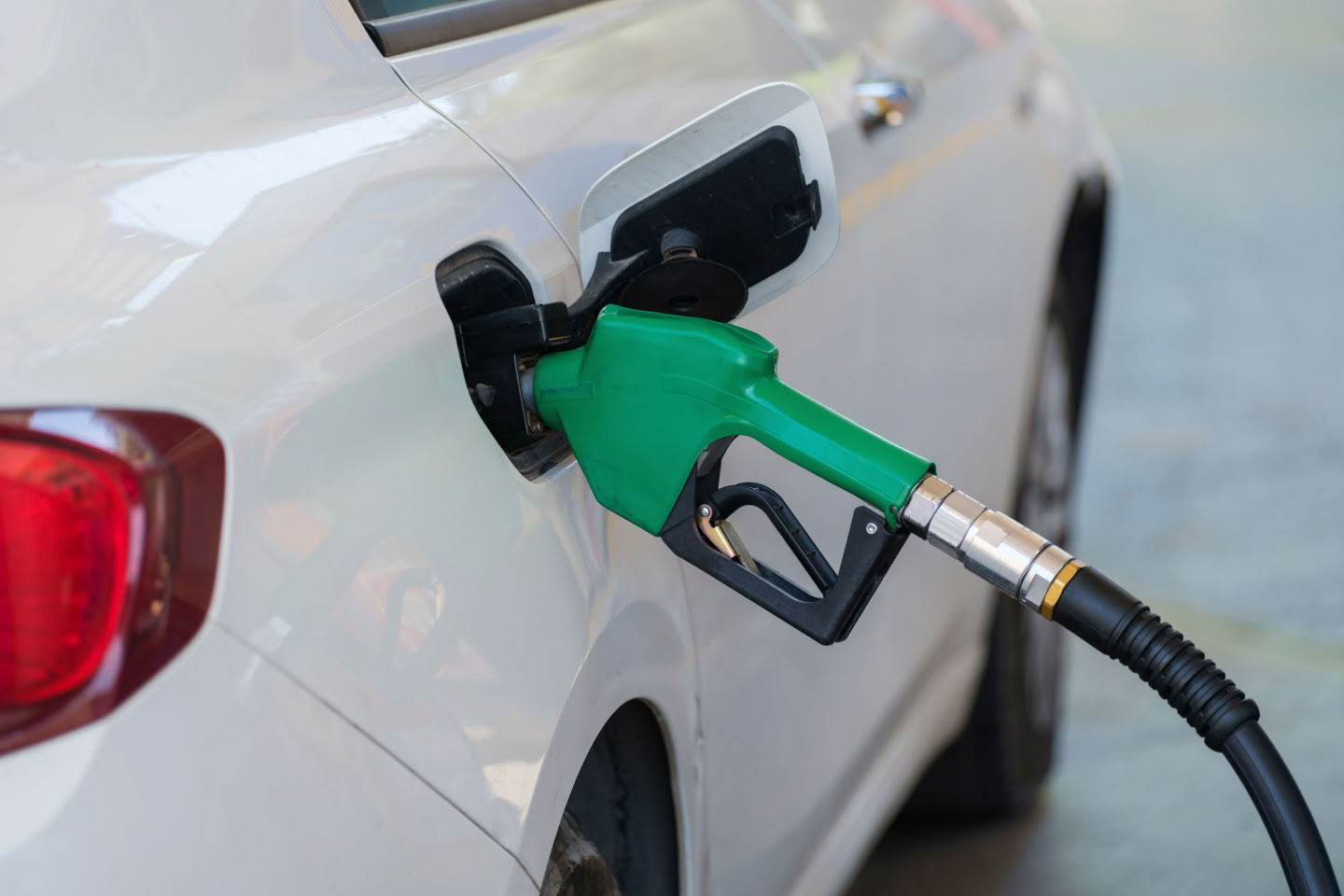
Gas pumped into car
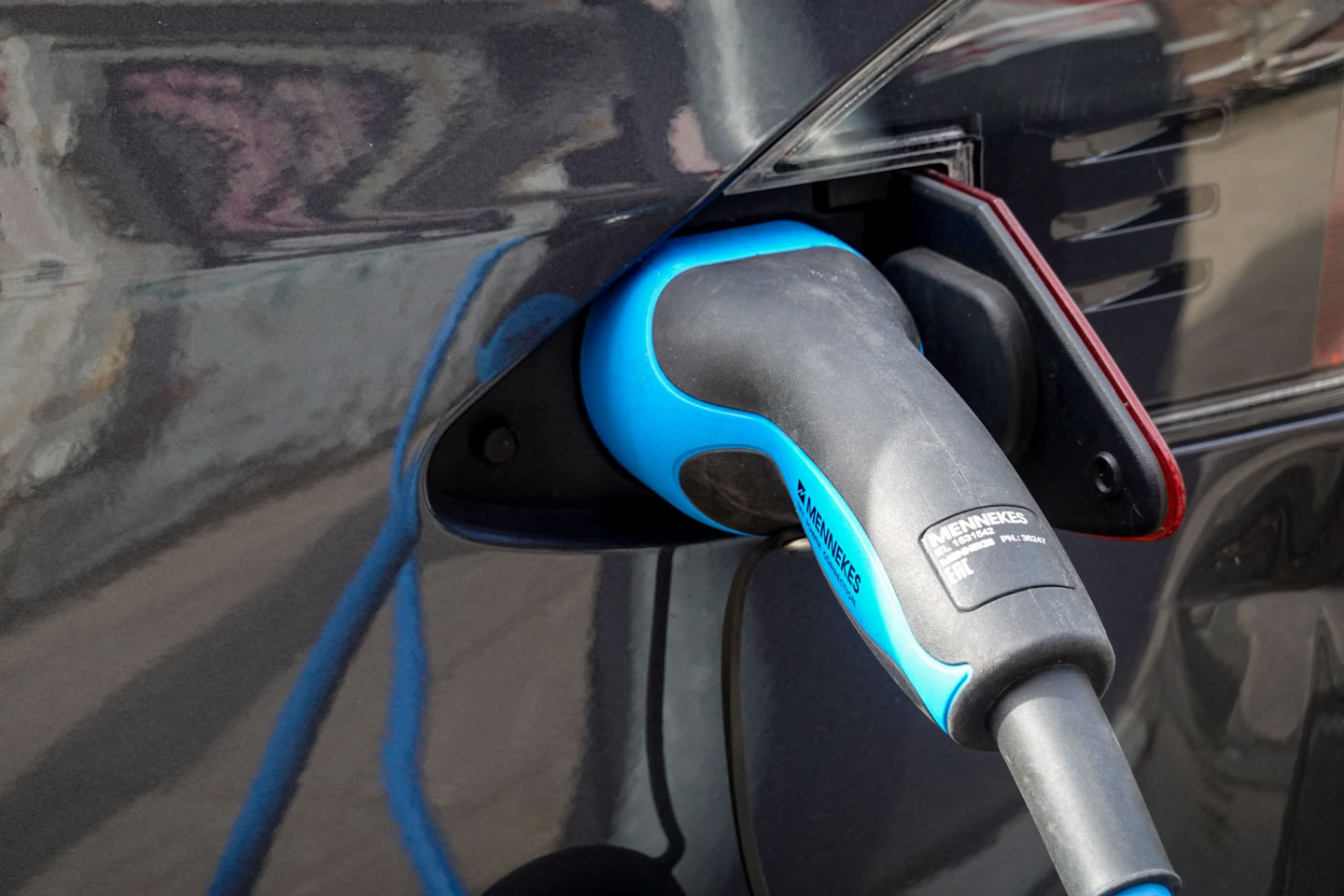
EV charging plug

The debate over gasoline-powered vehicles and electric vehicles is often reduced to one simple observation: gasoline cars have tailpipes and electric vehicles do not. True enough. But that tells only part of the story.

Comparing the environmental impact of gasoline and battery-electric vehicles sounds as though it should produce a simple answer, but it rarely does. The difficulty is deciding what should be counted, how much importance each consideration deserves, and what assumptions should be made about the future. Change one assumption and the conclusion can change with it. Different studies may also use different boundaries, data sources, vehicle lifetimes, and methods of calculating emissions, making apparently contradictory results possible without either calculation necessarily being wrong. The question is therefore less about finding one universally correct number and more about understanding the assumptions behind the comparison. When the entire life cycle is considered, the answer is inevitably more complicated than “gasoline bad, electric good,” or the reverse.

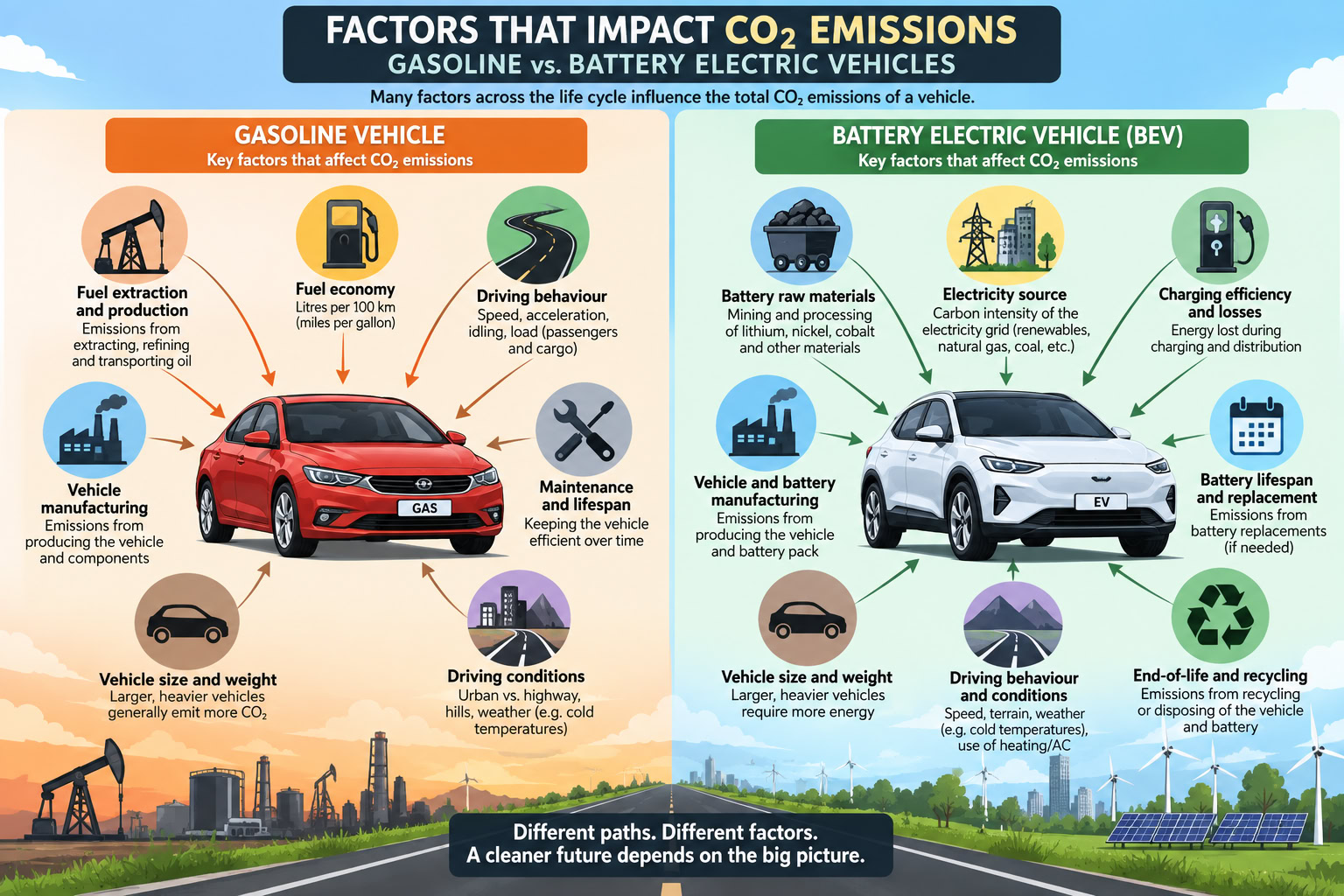
Infographic comparing gasoline and battery electric vehicles, showing factors impacting CO2 emissions. The left side features a red gasoline vehicle with related icons, and the right side features a white electric vehicle with related icons. The background includes an industrial landscape on the left and a green landscape on the right.

‍Every vehicle has an environmental and energy cost before it travels its first kilometre. Raw materials must be extracted, refined and transported. Factories consume energy. Batteries, engines, transmissions, electronics, steel, aluminum, plastics and glass all have to be manufactured. Then the vehicle spends perhaps 15 or 20 years consuming energy before eventually being scrapped, recycled or exported somewhere to begin a surprisingly persistent second life.

‍A meaningful comparison therefore needs to examine the entire lifecycle of each mode of transportation.

‍A Life Cycle Assessment (or Life Cycle Analysis) is a systematic method used to quantify the environmental impacts associated with all stages of a product or service’s lifecycle. From resource extraction, manufacturing, distribution, and use, to disposal or recycling, LCA examines the complete picture. The goal is to identify hotspots where environmental harm occurs and provide a foundation for making more sustainable choices.

‍Common areas assessed in an LCA include:

‍• Greenhouse gas emissions (carbon footprint)

‍• Energy and water consumption

‍• Resource depletion

‍• Waste generation

‍• Ecosystem and human health impacts

‍An LCA helps businesses understand trade-offs, benchmark performance, and comply with reporting expectations. It’s also increasingly used to support eco-design, circular economy strategies, and sustainability claims.

‍Institute of Sustainability Studies


Stage 1: Getting the Raw Materials

A gasoline vehicle requires large quantities of steel, aluminum, copper, plastics, glass and other materials. Producing these materials involves mining, refining and considerable energy consumption.

This gives gasoline vehicles an important advantage at the beginning of their lives.

But gasoline vehicles have their own raw-material requirement that continues throughout their lives: petroleum.

The oil isn't simply sitting at the neighbourhood gas station waiting to jump into your tank. It must be explored for, extracted, transported, refined into gasoline and transported again to filling stations. This process continues for every litre the vehicle burns.

An electric vehicle needs most of those same materials, but adds one particularly significant component: a large battery.

Modern EV batteries require substantial quantities of materials such as lithium, graphite, nickel, manganese, iron, phosphate and copper, depending on battery chemistry. Mining and processing these materials can involve large open-pit or underground operations, substantial water and energy consumption, transportation and chemical processing.

Manufacturing an EV, particularly its battery, generally produces more greenhouse-gas emissions than manufacturing a comparable gasoline vehicle.

An EV's battery represents a large upfront material investment.

Stage 2: Manufacturing

Manufacturing the body, interior and many other components of gasoline and electric vehicles is broadly similar.

The big difference is the powertrain.

A gasoline vehicle requires an internal-combustion engine containing hundreds of components, along with fuel injection, exhaust and emission-control systems and usually a multi-speed transmission.

An electric drivetrain is mechanically simpler. Electric motors have relatively few moving parts, and EVs generally don't require conventional multi-speed transmissions.

Producing a large lithium-ion battery is energy intensive, which means an EV typically leaves the factory with a larger carbon footprint than an equivalent gasoline vehicle.

Stage 3: Producing the Energy

That fact sometimes gets presented as proof that EVs aren't environmentally beneficial. It isn't. It simply means the EV starts the race behind. What happens during the next 200,000 kilometres matters considerably more. This is where the comparison becomes complicated.

Gasoline has to be continually produced and delivered. Oil extraction consumes energy. Pipelines, ships, trains and trucks transport petroleum. Refineries consume additional energy converting crude oil into gasoline, which must then be distributed.

And after all that effort, the gasoline finally reaches an engine that is remarkably good at producing heat.

Only a fraction of gasoline's energy ultimately reaches the wheels. Much of it disappears as waste heat through the engine, cooling system and exhaust.

Electric motors are substantially more efficient at converting supplied electrical energy into motion. But electricity isn't automatically clean.

An EV charged primarily from coal-generated electricity has a substantially larger operating carbon footprint than one charged in Ontario, Quebec or another jurisdiction where electricity comes largely from nuclear, hydroelectric and other low carbon sources.

This means there is no universal answer to the question, "How clean is an electric car?"

It depends enormously on where it is charged.

Stage 4: Driving

Once the vehicles are on the road, the lifecycle balance generally begins shifting toward the EV.

Every kilometre driven in a gasoline vehicle requires combustion. Carbon dioxide is an unavoidable product of burning hydrocarbon fuel. Modern catalytic converters can dramatically reduce pollutants such as carbon monoxide, hydrocarbons and nitrogen oxides, but they cannot eliminate the carbon dioxide produced by combustion.

An EV produces no tailpipe emissions because it has no tailpipe. Its emissions instead occur mainly where its electricity is generated.

In regions with relatively clean electrical grids, this creates a substantial lifecycle advantage. Even in regions using significant fossil-fuel generation, EVs can retain an efficiency advantage because large power plants and electric drivetrains can convert energy more efficiently than millions of individual internal-combustion engines.

The electricity grid can also become cleaner during the vehicle's lifetime. A gasoline vehicle purchased today will still burn gasoline in 2036. An EV purchased today could gradually become lower-carbon if the electricity system supplying it changes.


Stage 5: Maintenance

Gasoline vehicles require engine oil, filters, spark plugs and numerous other maintenance items. Engines and transmissions contain many moving components exposed to heat, pressure and friction.

Electric vehicles eliminate much of the machinery.

They still require tires, suspension components, bearings, brakes, cooling systems and other maintenance, so they certainly aren't maintenance-free.

EVs can also be heavy because of their batteries. Additional weight can increase tire wear, although regenerative braking can significantly reduce conventional brake wear.

The battery itself eventually deteriorates. How quickly depends on chemistry, temperature, charging patterns, vehicle design and usage. Replacing a large battery outside warranty can be expensive, although battery longevity has improved considerably as the technology has matured.


Stage 6: End of Life

Eventually both vehicles reach the scrapyard.

Cars with internal combustion engines are commonly recycled and a huge secondary materials industry has existed for a very long time.

Steel, aluminum, copper and many conventional automotive components already have mature recycling markets.

In addition, many components from end-of-life cars are reused or rebuilt so they can be used again. 

EV batteries create a new challenge.

A used automotive battery contains  lithium, nickel, cobalt and copper.

Some used car batteries may also be reused in stationary energy-storage applications.

Building sufficient EV recycling capacity will take time.

So Which Vehicle Wins?

Across the complete lifecycle, electric vehicles generally produce lower greenhouse-gas emissions than comparable gasoline vehicles, particularly when driven for many years and charged from relatively low-carbon electricity.

But that conclusion shouldn't be turned into the equally simplistic claim that EVs are "zero emission."

They aren't.

Electric vehicles require mining. Their batteries require energy-intensive manufacturing. Electricity generation has environmental consequences. Roads, tires, steel, aluminum and factories don't suddenly become environmentally harmless because the vehicle has a charging port.

Gasoline vehicles usually have a smaller manufacturing footprint, but they accumulate emissions continuously throughout their operating lives because they require an endless supply of petroleum.

That difference is fundamental.

The EV carries more of its environmental burden upfront. The gasoline vehicle keeps adding to its burden every time the driver fills the tank.

There is another inconvenient consideration frequently missing from the argument: replacing a perfectly serviceable vehicle has an environmental cost too.

Keeping an existing gasoline vehicle for several more years may sometimes make more sense than immediately scrapping it simply to purchase a new EV. Likewise, a smaller efficient vehicle, whether gasoline-powered or electric, will generally require fewer resources than an enormous vehicle hauling one person to the grocery store.

Technology matters, but size, electricity source, annual kilometres driven and how long we keep our vehicles matter too.

The gasoline-versus-electric debate therefore isn't really a contest between "dirty" and "clean."

It is a comparison between two industrial systems with environmental costs occurring at different stages.

When the entire lifecycle is considered, EVs generally have the advantage, especially where electricity is relatively low-carbon. But they don't eliminate environmental costs. They shift many of them from continuously extracting and burning fuel toward producing electricity, manufacturing batteries and recovering materials.

That's considerably less exciting than declaring one side virtuous and the other evil.

Unfortunately, reality has an irritating habit of being complicated.

For a Canadian audience, this could be made considerably stronger by adding actual **CO-equivalent figures for manufacturing, battery production, electricity generation and 200,000 km of driving**, with a specific comparison for Ontario's relatively low-carbon electricity grid.

As if comparing the lifecycle emissions of gasoline and electric vehicles were not complicated enough, there is an entirely separate economic dimension to consider. The environmental calculation tells only part of the story. Consumers must also consider what a vehicle costs to buy, operate, maintain, insure, repair, and eventually replace.

There is a strong argument for allowing consumers and the free market to play a larger role in determining which technologies succeed. Rather than governments attempting to choose a preferred technology through mandates, subsidies, or penalties, consumers can weigh purchase price, operating costs, convenience, performance, reliability, environmental concerns, and their own circumstances. Manufacturers, in turn, must compete to produce vehicles people actually want at prices they are willing to pay. If electric vehicles offer sufficient advantages, they should increasingly attract buyers without requiring permanent government support; if gasoline, hybrid, or other technologies remain competitive, consumers should remain free to choose them. Government can still establish safety and environmental standards, but market competition can determine how manufacturers meet those standards rather than prescribing a particular technological solution.

Governments may support the EVoffer subsidies, tax incentives, charging infrastructure, and other public expenditures. These costs are not always obvious because some appear on the buyer’s invoice while others are distributed among taxpayers or buried in broader government programs. A vehicle that appears environmentally preferable may not necessarily be the most economical choice in every circumstance, just as the cheapest vehicle to purchase may not be the least expensive over its lifetime. Once economics is added to lifecycle emissions, the seemingly simple question of “gas or electric?” becomes considerably harder to answer.
Governments around the world generally use five broad types of policy to encourage EV adoption. The exact mix varies considerably by country, province/state, and year.


1. Purchase subsidies and rebates: Direct payments or point-of-sale discounts reduce the price of an EV. Canada, for example, currently offers eligible buyers up to $5,000 under its federal Electric Vehicle Affordability Program. 1


2. Tax incentives and exemptions: Governments may reduce sales, purchase, registration, import, or business taxes for EVs. Unlike a direct subsidy, some of these incentives represent government revenue that would otherwise have been collected. 2


3. Charging-infrastructure subsidies: Public money is used to build charging networks or subsidize chargers in homes, workplaces, apartment buildings, and public locations. This indirectly encourages EV purchases by making charging more convenient. 3


4. EV sales requirements and emissions regulations: Governments can require manufacturers to meet zero-emission-vehicle targets or increasingly stringent fleet-emission standards. Canada is currently pursuing strengthened vehicle GHG standards alongside national EV sales targets. 4


5. Preferential treatment for EV owners: Depending on the jurisdiction, EVs may receive reduced registration charges, free or discounted parking and tolls, access to restricted areas, or other operating advantages. 5


These policies influence the market in different ways. Rebates and tax breaks alter the consumer's financial calculation, infrastructure spending addresses convenience, while mandates and emissions regulations affect what manufacturers can profitably offer.

In other words, the apparent market price and consumer demand don't necessarily tell the whole economic story once government intervention enters the equation.

Sources:

1. "Policies to promote electric vehicle deployment – Global EV Outlook 2021 – Analysis - IEA"

2. "Electric vehicles - Incentives - Canada.ca"

3. "Trends in electric cars – Global EV Outlook 2026 – Analysis - IEA"

4. "Electric vehicles – Policies and regulations - Canada.ca"

5. "Transport – Energy Efficiency Policy Toolkit – Analysis - IEA"

Website uses cookies. Privacy Policy.