The American Democratic Party presents itself as the defender of working families, individual freedom, democracy, and competent government. Its actual agenda tells a less flattering story: a party increasingly comfortable with centralized power, expansive spending, selective definitions of freedom, and policies whose costs are routinely transferred to taxpayers, consumers, employers, and future generations.
Democrats support a larger federal government because they believe government-directed solutions are generally fairer than solutions produced by markets, states, communities, or families. Their 2024 party platform—the party’s latest adopted national platform—calls for expanded healthcare subsidies, subsidized childcare, student-debt relief, housing assistance, green-energy investment, stronger unions and numerous new or enlarged federal programs.
Each proposal is marketed separately as help for someone who needs it. Rarely emphasized is the cumulative bill. Programs require taxes, borrowing or inflationary financing. Regulations impose costs even when those costs never appear in the federal budget. Democrats frequently promise that only corporations and wealthy Americans will pay, as though businesses do not respond to higher costs through prices, wages, investment decisions and relocation.
The party supports progressive taxation, greater corporate taxation and more aggressive government involvement in the economy. It does not support the proposition that leaving more money and decision-making authority in private hands is itself a legitimate public policy. Success is too often treated as a taxable resource first and an achievement second.
Immigration: enforcement after the damage is done
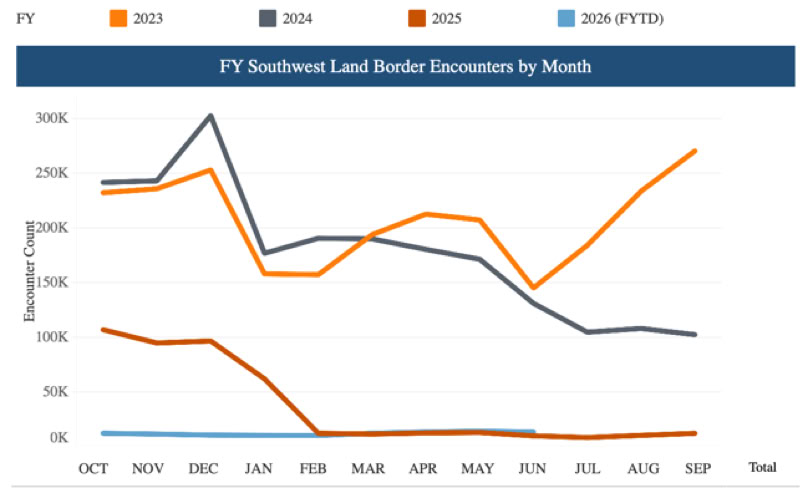
Democrats officially claim to support border security. Their platform calls for more border personnel, immigration judges and asylum-system resources. Those positions, however, came after years in which leading Democrats minimized illegal immigration, resisted enforcement measures and attacked many restrictionist proposals as cruel or xenophobic.
The result was an entirely predictable loss of public confidence. A government that cannot—or will not—consistently determine who enters, who remains and who must leave is failing at one of its most elementary responsibilities.
The contradiction is particularly glaring when Democrats discuss illegal immigrants primarily as future citizens, workers or victims while treating Americans concerned about wages, housing, public services and security as morally suspect. Compassion does not require the abandonment of limits.
Democrats generally support legalization pathways, refugee admissions, protections for “Dreamers” and a broader asylum system. What the party does not reliably support is swift removal, strong deterrence and an immigration level explicitly tied to the country’s capacity to absorb newcomers. Even its eventual turn toward enforcement appeared less like conviction than an election-year response to political pressure.
Abortion: “choice” without an honest limiting principle
The party strongly supports restoring the protections associated with “Roe v. Wade”, protecting abortion medication and restricting states’ ability to prohibit abortion. The Democratic National Committee describes abortion access as a fundamental matter of reproductive freedom. That position is explicit in the party’s own platform summary.
What Democrats conspicuously resist is a candid discussion about limits. Party messaging relies on the most emotionally compelling cases—rape, incest and medical emergencies—while Democratic politicians are often evasive when asked what restrictions they would accept later in pregnancy.
A party that insists every gun regulation is a reasonable safeguard suddenly becomes allergic to regulatory boundaries when the subject is abortion. “Trust women” replaces the need to explain when developing human life deserves legal protection. That is not a complete ethical argument. It is a slogan designed to end one.
Guns: constitutional rights by government permission
Democrats support universal background checks, an “assault weapons” ban, restrictions on high-capacity magazines, red-flag laws and greater federal oversight of gun ownership. The DNC has openly endorsed these measures.
The party does not support a robust interpretation of the Second Amendment. It treats gun ownership less like a constitutional right and more like a potentially dangerous privilege that government may continually narrow.
Democratic proposals also suffer from deliberate vagueness. “Assault weapon” is a politically useful phrase but an imprecise description frequently based on cosmetic characteristics. Law-abiding owners become the easiest people to regulate precisely because criminals, by definition, ignore regulations.
Democrats speak constantly about root causes in other areas of crime and social policy. When firearms are involved, the object itself conveniently becomes the root cause.
Energy and climate: higher costs disguised as transformation
Democrats support aggressive emissions reductions, renewable-energy subsidies, electric-vehicle adoption and extensive federal direction of energy markets. Climate change is a real concern, but acknowledging the problem does not validate every policy offered in its name.
The party routinely understates the cost, physical infrastructure and reliability challenges of its preferred transition. Wind turbines, solar panels, batteries and electric vehicles require minerals, manufacturing, transmission lines and dependable backup generation. They are not produced by speeches or regulatory deadlines.
Democrats do not support an energy policy centered on abundant domestic fossil-fuel production, streamlined permitting and consumer choice. Although Democratic administrations sometimes permit more drilling when prices or political pressure demand it, the party’s activist wing treats oil and natural gas as industries to be phased out rather than strategic assets to be used responsibly.
Families experience energy policy through electricity bills, heating costs, transportation expenses and the price of everything moved by truck. Grand climate ambitions are much easier to celebrate when somebody else is paying the utility bill.
Education: institutions first, parents second
Democrats strongly support teachers’ unions, increased public-school spending, federal student aid and student-loan cancellation. They are much less enthusiastic about school choice, education savings accounts and other mechanisms that allow funding to follow children out of poorly performing systems.
This reveals the party’s institutional priorities. When the interests of unions and education bureaucracies conflict with parental control, Democratic politicians too often side with the institutions that organize, donate and vote for them.
Student-debt cancellation is another example of progressive rhetoric concealing regressive policy. It transfers obligations voluntarily incurred by borrowers—including many people with valuable degrees and strong lifetime earning prospects—to taxpayers who may not have attended college or who already repaid their own loans.
Democrats call this relief. Millions of Americans can reasonably call it an invoice for someone else’s choices.
Crime and public order: endless sympathy, inconsistent accountability
Not every Democrat supported “defund the police,” and the national party subsequently tried to distance itself from the slogan. Nevertheless, the movement flourished within progressive Democratic politics for a reason. It reflected a worldview in which law enforcement was frequently portrayed as the central problem while offenders were discussed primarily as products of social conditions.
Reform and accountability are necessary. So are prosecution, incarceration and visible public order. Citizens should not have to choose between professional policing and effective policing.
The party supports extensive analysis of why crimes occur. It is less dependable when asked to defend the uncomplicated principle that repeat offenders should be removed from the streets before they create more victims.
## What Democrats do not support
Taken as a whole, today’s Democratic Party does not reliably support limited federal government, low taxation, broad energy freedom, strong immigration deterrence, expansive gun rights, parental control of education or an abortion policy with a clearly articulated limiting principle.
It may occasionally borrow the language of these ideas when public opinion demands it. But its governing instinct points in the opposite direction: more federal authority, more spending, more regulation and more decisions transferred from citizens to credentialed institutions.
The deepest problem is not that Democrats want to help people. Most political movements claim that intention. The problem is their persistent belief that good intentions excuse weak incentives, ballooning costs, bureaucratic failure and restrictions on anyone who refuses to accept the party’s preferred solution.
Democrats promise protection from hardship, risk, inequality, misinformation, discrimination, climate change, medical expenses, tuition costs and economic uncertainty. The price of that promised protection is always more power for the institutions offering it.
Voters should ask a simple question: If a party’s answer to nearly every problem is more government, when—if ever—will it decide that government has enough?